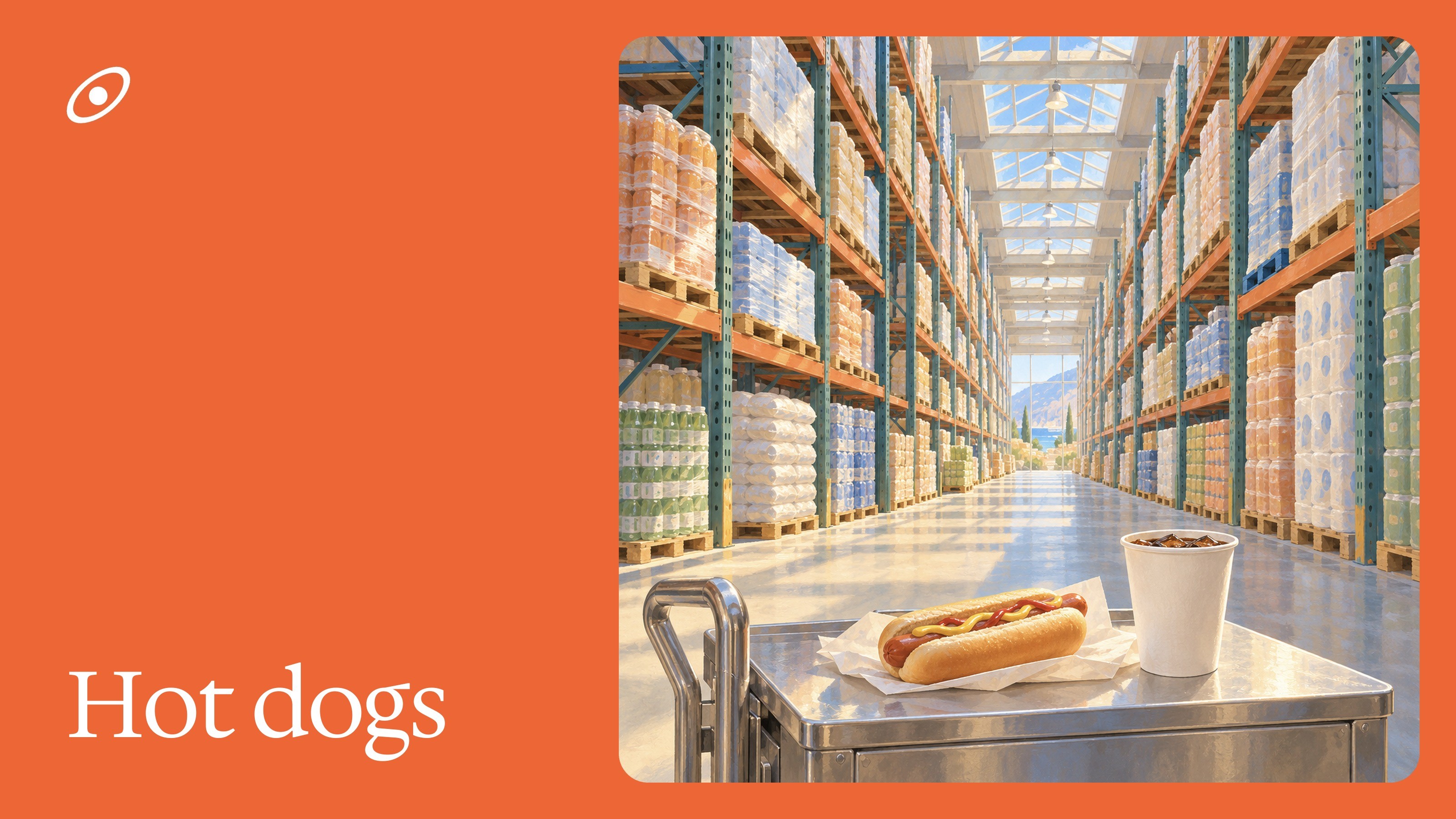
The hot dog and soda combo at Costco has cost $1.50 since 1985. Inflation has more than tripled most prices since then. The hot dog got bigger, the cup got bigger, and the price stayed put.
Most people treat this as a quirk. It is closer to the whole business model printed on a menu board.
Costco does not make its money on things
Costco caps its markup on branded goods at around 14 percent, and a bit more on its own Kirkland label. A normal supermarket marks up far more. On the goods themselves, Costco barely clears its costs.
The profit comes from the card in your wallet. Membership fees are a small slice of revenue and most of the operating profit. Renewal rates in the US and Canada sit around 90 percent. The store is, in effect, a subscription that happens to sell tires and rotisserie chickens.
The hot dog is the ad
Once you see it that way, the $1.50 combo stops being a loss. It is a marketing line that pays for itself in renewals. Every member who walks out past the food court gets the same message: nobody here is trying to squeeze you.
The cheap lunch is not a product. It is proof of a promise, repeated more than a hundred million times a year.
When an executive once raised the idea of a price increase, the co-founder's answer has become company legend: if you raise the hot dog, I will kill you. The story spreads because it is simple, and because it is about trust, not food.
What you can borrow
Most businesses have a hot dog, even if they have never named it. It is the one visible price or policy customers use to judge everything else.
Three questions are worth asking about yours:
-
Which number do customers remember? It is rarely your headline price. It is the delivery fee, the cancellation rule, the cost of a coffee refill.
-
Where does the money really come from? If it is retention, protect the signal that keeps people around, even at a loss.
-
What would you refuse to change? A promise is only a promise if it survives a bad quarter.
Costco could add a few cents to the hot dog and nobody would leave. That is exactly why it doesn't.